What is the OLED technology all about?
OLEDs are made from organic (carbon based) materials that emit light when electricity is applied. Because OLEDs do not require a backlight and filters (unlike LCD displays), they are more efficient, simpler to make, and much thinner. OLEDs have a great picture quality – brilliant colors, fast response rate and a wide viewing angle.
LG 15-inch OLED prototype
OLEDs can also be used to make OLED – thin, efficient and without any bad metals.
OLLA White Light Prototype
OLED materials have been discovered back in 1960, but only in the past 20 years or so have researchers started to actually work on the technology. A complete. You can read more about OLED displays and advantages in our page.
How do OLEDs work?
The basic structure of an OLED is a cathode (which injects electrons), an emissive layer and an anode (which removes electrons). Modern OLED devices use many more layers in order to make them more efficient, but the basic functionality remains the same.
How an OLED panel is made
Making an OLED involves several steps: taking a substrate, cleaning it, making the backplane (the switching and driving circuitry), depositing and patterning the organic layers and finally encapsulation the whole thing to prevent dust, oxygen and moisture damage.
There are several ways to deposit and pattern the organic layers. Currently all OLED displays are made using vacuum evaporation, using a Shadow Mask (FMM, Fine Metal Mask) to pattern. This is a relatively simple method but it is inefficient and very difficult to scale up to large substrates. There are several alternatives for next-gen deposition techniques, including laser annealing and inkjet printing. These methods will be scalable and more efficient than vacuum deposition.
OLED materials
There are several types of OLED materials. The most basic division is between small-molecule OLEDs and large molecule ones (called Polymer OLEDs, or P-OLEDs). Almost all OLEDs made today are SM-OLED based. These materials are evaporable and far more advanced than P-OLEDs. P-OLEDs had great promise and are solution processable (and so can be used in InkJet printing and spin-coating fabrication methods). Intensive research is being performed to develop efficient solution-processable SM-OLEDs.
Another interesting division is between Fluorescent and Phosphorescent materials. Fluorescent materials last longer (and were discovered first) but are much less efficient than Phosphorescent materials. Most people agree that the future of OLEDs (especially in large-area displays and lighting panels) lie with Phosphorescent materials, although there are still challenges in developing a long-lasing blue Phosphorescent OLED. It is possible to combine these materials though, and today Samsung for example use a red PHOLED together with Fluorescent green and blue. Is pioneering PHOLED research, holding basic patents in this area.
AMOLED vs PMOLED
These terms relate to the driving method of the OLED display. A (Passive-Matrix OLED) is limited in size and resolution, but is cheaper and easier to make than an (which uses an Active-Matrix). An AMOLED uses an active-matrix TFT array and storage capacitors. While these displays are more efficient and can be made large, they are also more complicated to make.
displays are used in mp3 players or secondary displays on cell phones while AMOLEDs are used in smartphone displays, digital cameras and TVs.
Challenges
The two major challenges facing the OLED industry is the lifetime of the panels (OLED panels still lag behind plasma and LCD displays) and production scaling beyond Gen-5.5.
OLED technology today
Today OLED displays are used mainly in small (2″ to 5″) displays for mobile devices such as phones, cameras and MP3 players. OLED displays carry a price premium over LCDs, but offer brighter pictures and better power efficiency – making it ideal for battery powered gadgets.
Samsung Galaxy S
Making larger OLEDs is possible, but difficult and expensive. There are some OLED TVs available, but these are expensive. Sony has announced the XEL11quot; OLED TV back in 2007 – at about $2,500 (they aren’t producing it anymore and now focus on professional OLED monitors). LG is also offering an OLED TV (the 15″ ) which is also expensive and isn’t being mass produced. Mass production of price-competitive sets will probably begin towards the end of 2012 or early 2013.
In the OLED lighting market, several companies (such as Philips, OSRAM and Lumiotec) are already shipping OLED panels, but these are small and very expensive, mostly used in premium lighting fixtures and as experimental design kits.
Future Tech: Transparent / Flexible OLEDs
In the future, companies will be able to produce and OLED panels. This will open up a whole world of exciting applications, such as:
- Curved OLED displays, placed on non-flat surfaces
- Rollable screens
- Wearable OLEDs
- Transparent OLEDs embedded in windows
- Exciting new OLED lamp designs
And many more we cannot even imagine today…
TRI 4.1 Flexible AMOLED prototype
Flexible OLEDs require that the entire device is flexible – including the electronics and the encapsulation layer. Several companies are working on this technology, using either plastic or metal based displays (it’s also possible to use very thin flexible glass). It isTransparent OLEDs are also difficult to make, although these are already in production: since May 2011 for mobile phones and other applications.
Flexible OLED displays
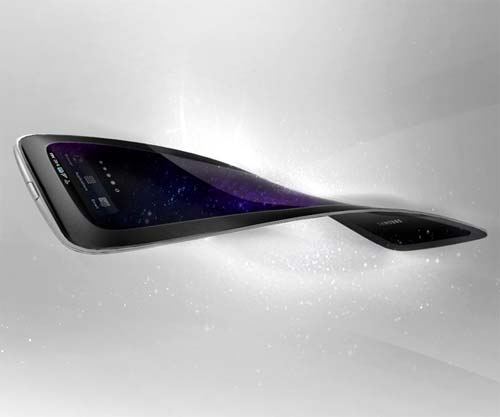
OLED is a new display technology. Using light-emitting organic materials, beautiful and efficient displays can be created. OLEDs are very thin, and in fact can be put on flexible materials (plastic or metal foil). So it’s possible to make bendable, flexible displays. Because these displays will not be covered with glass, they’ll also be more durable – and virtually shatter-proof.
Flexible OLED products
Flexible OLEDs are still in the R&D phase – and there aren’t any products on the market yet. Samsung seems to be the closest to commercialization, and the company said that probably for mobile phones. These will probably be curved OLEDs that will not be bendable.